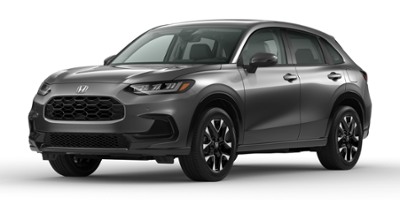
2027 Honda HR-V Sport FWD: Is the Trim Premium Worth It?
At $28,400, the Sport FWD costs $1,800 more than the base LX FWD and just $300 more than the LX AWD. Here's what that gap actually buys.
By IFMG Editorial ·
Get Invoice Price on a new HRV
Start your negotiation knowing what the dealer paid
Get Invoice Price
The math: $1,800 more, same MPG
The Sport FWD lists at $28,400 against the LX FWD's $26,600 — a $1,800 gap, about 6.8% more. Unlike a lot of trim-walk premiums, this one doesn't cost anything in fuel economy: both trims are rated 26 mpg city, 32 mpg highway, 28 mpg combined, putting their estimated 5-year fuel cost at an identical $9,375 under the standard 15,000-mile, $3.50/gal assumptions. The entire premium is equipment, not an efficiency trade-off. By the lineup's value index — mpg per $1,000 of MSRP — the LX FWD still scores higher at 1.05 versus the Sport FWD's 0.99, but that metric only tracks price against unchanged fuel economy. It doesn't credit what the extra money actually buys, which is where the Sport trim makes its case.
What the $1,800 actually buys
The equipment list shows real, usable differences rather than badge-only changes. Sport FWD adds Blind Spot Information (BSI) System and Cross Traffic Monitor as standard — neither appears on the base trim's spec sheet. It also adds heated front bucket seats, a leather-wrapped steering wheel, and a leather/metal-look shifter in place of the entry trim's urethane piece. The audio system steps from 4 speakers to 6. Wheels grow from 17-inch Pewter Gray alloys on 215/60R17 tires to 18-inch Gloss Black alloys on 225/55R18 rubber. Smaller items stack up too: power mirrors become heated and body-colored with turn signal indicators, the front visor vanity mirrors gain illumination, and the passenger window gets one-touch up/down to match the driver's side. This is a documented list of standard features the cheaper trim simply doesn't have — not aspirational marketing.
Get Invoice Price on a new HRV
Start your negotiation knowing what the dealer paid
Get Invoice PriceThe AWD comparison changes the calculus
Here's the wrinkle worth sitting with: the Sport FWD costs just $300 more than the LX AWD ($28,400 vs $28,100, about 1.1%). That's a genuine fork in the road. The LX AWD trades the Sport's safety tech, heated seats, and 18-inch wheels for all-wheel traction and nothing else gained — it runs the same 4-speaker audio and 17-inch wheels as the base FWD trim. Buyers deciding between these two near-identical price points are really choosing between drivetrain and equipment, not drivetrain and savings. Anyone who doesn't need AWD traction gets considerably more content for almost the same outlay by going Sport FWD instead. Readers weighing that trade-off directly can see what the HR-V LX AWD gives up on the equipment side to get the extra drive wheels.
Where Sport AWD and EX-L fit around it
Stepping up from Sport FWD to Sport AWD costs $1,500 more, about 5.3%, and drops combined economy from 28 mpg to 27 mpg combined, pushing the estimated 5-year fuel cost to $9,720 — a $345 increase over the Sport FWD's $9,375. That buys all-wheel drive on top of the Sport equipment set, a reasonable trade for buyers who need the traction. Moving past Sport into EX-L territory costs more again: the EX-L FWD runs $2,050 above the Sport FWD, about 7.2% more, and adds dual-zone automatic climate control, a power sunroof, 8-speaker audio, leather-trimmed seats, and front/rear parking sensors — a bigger jump in content than the LX-to-Sport step, but a bigger price jump too. For a buyer who already wants Sport-level safety gear and trim but not sunroof-and-leather extras, Sport FWD is the stopping point that makes sense on paper.
Who should skip the upgrade
The LX FWD remains the strongest value by the numbers — its 1.05 mpg-per-$1,000 index tops the lineup, and the cost-per-commute math laid out in the site's HR-V commuter guide applies just as well to it as to pricier trims, since fuel economy doesn't change with equipment level. Buyers who don't care about blind spot monitoring, heated seats, or 18-inch wheels, and who want the lowest entry price in the range, have no efficiency reason to move up. But anyone cross-shopping Sport trims for daily driving will want to weigh the Sport AWD page's traction case against the FWD version's price advantage before locking in a configuration.
By the Numbers
Assumes 15,000 miles a year and $3.50 per gallon.
Frequently Asked Questions
Based on published pricing and equipment, the HR-V lineup offers a clear value hierarchy: the LX FWD posts the best mpg-per-dollar index at 1.05, while pricier trims add documented safety and comfort equipment at a cost. Whether it's 'worth it' depends on whether you value that added equipment over the lower entry price.
No. Both are rated 26 mpg city, 32 mpg highway, 28 mpg combined. The Sport trim's premium is entirely about equipment, not a fuel economy trade-off.
They're $300 apart, with Sport FWD slightly cheaper than LX AWD's... actually Sport FWD costs $300 more than LX AWD. Choose LX AWD if you need all-wheel traction; choose Sport FWD if you value blind spot monitoring, heated seats, and 18-inch wheels more than AWD.
The Sport AWD costs $1,500 more than the Sport FWD, about 5.3%, and drops combined fuel economy from 28 mpg to 27 mpg combined.
The EX-L FWD costs $2,050 more than the Sport FWD, about 7.2%, and adds dual-zone automatic climate control, a power sunroof, 8-speaker audio, leather-trimmed seats, and front/rear parking sensors.
Bottom Line
The Sport FWD's $1,800 step up from the LX FWD buys standard blind spot monitoring, cross traffic monitor, heated seats, and larger wheels without costing any fuel economy — a straightforward, justifiable premium. Its near-parity with the LX AWD price makes the drivetrain-versus-equipment decision the real question for shoppers at this price point.
You want standard driver-assist tech (blind spot, cross traffic), heated seats, and 18-inch wheels, and you don't need all-wheel drive.
You prioritize the lowest entry price and don't need the added safety or comfort equipment — the LX FWD scores highest on value index.
These are current published MSRPs with no indication of pending changes in the provided facts; evaluate against the LX AWD's near-identical price before deciding.
Get Invoice Price on a new HRV
Start your negotiation knowing what the dealer paid
Get Invoice Price